Wolf Hood Blower Motor
| What it is | The motor that turns the blower wheel — in the canopy, in the duct, or outside on a roof or a wall. |
|---|---|
| Where it sits | Inside the canopy, in the duct, or out on the roof or wall |
| How it fails | Dead, or hums and will not turn, or runs hot and cuts out |
| Checked with | Voltage at the motor, then resistance and free rotation by hand |
| Price | Quoted after the $89 visit |
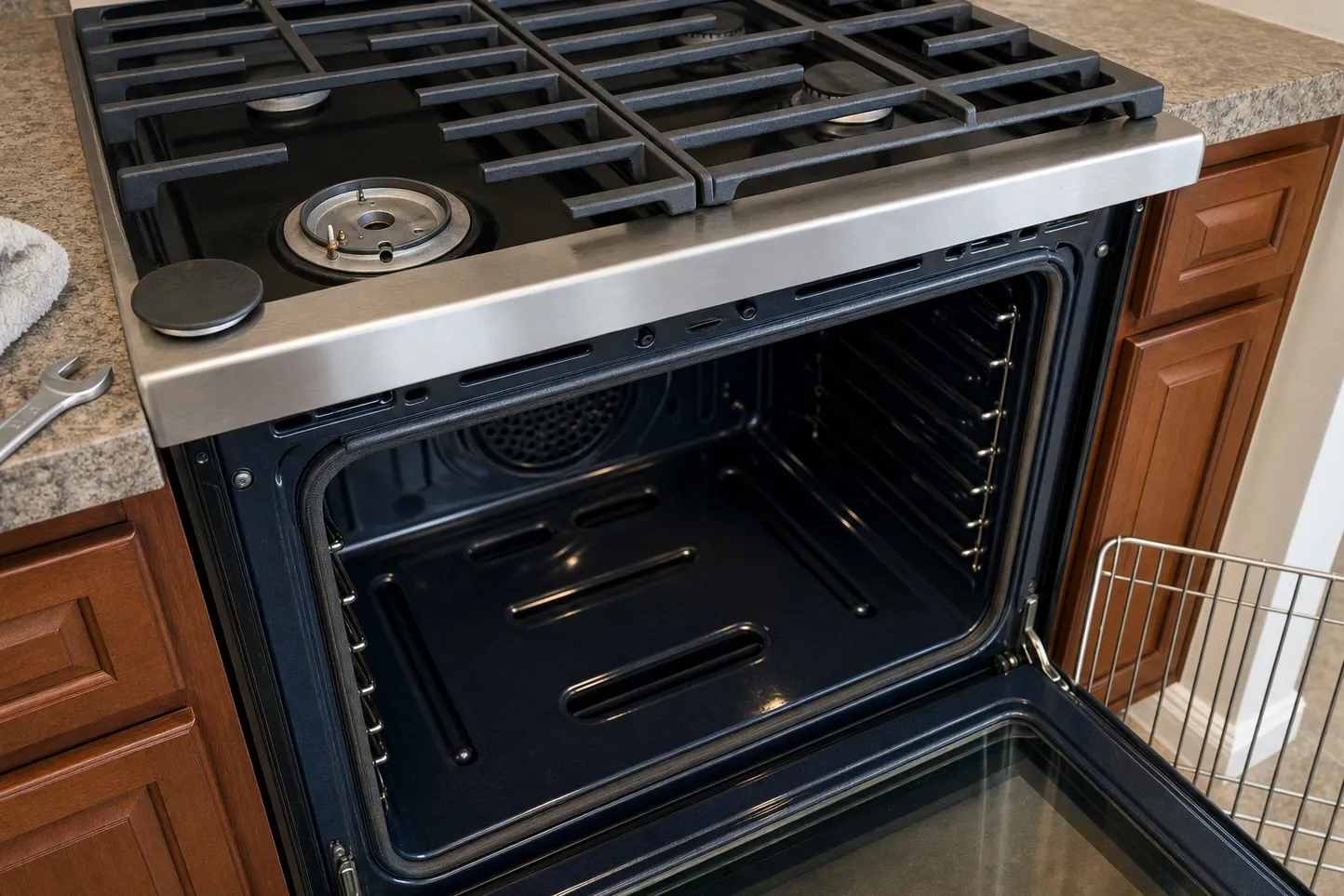
- Fan cover in the cavity
Where it actually is
Three sitings, and knowing yours is the most useful thing you can say on the phone. An internal blower is bolted into the canopy above the filters: easy to reach, loud in the room. An in-line blower sits in the duct, normally in an attic, so the hood is quieter and the failure is out of sight. A remote blower lives outside on a roof or wall — quieter again, and the one people forget exists. Plenty of owners have been told the hood is dead when the hood was never the problem.
How it fails, and what that sounds like
Three patterns are worth separating. Nothing at all, no sound and no movement. A hum with no rotation, which is the signature of the component that starts the motor rather than the motor itself. And a motor that runs, heats up and shuts down partway through cooking. Only the first is reliably the motor; the second is a capacitor until proved otherwise, and the third is usually air blocked downstream making the motor work harder than it was built to.
What gets measured first
Voltage at the motor, not at the switch — a wall control and a long low-voltage run can both drop out on the way. Then the wheel turned by hand with the power off, because a dry bearing has a feel to it and so does a wheel packed with grease. Then resistance across the windings. A motor that passes all three and still will not spin is being let down by something in front of it, which is the cheaper answer.
What putting it right costs
This one has no published band. Wolf Repair Los Angeles puts a figure on it after the diagnosis, as one number covering the part and the labour, and nothing is ordered until you have agreed it — (310) 626-4008.
A flat $89 buys the call-out and a full diagnosis, and that $89 is deducted from the repair once you have approved it.
Follow-ups
How do I know whether my blower is in the hood or somewhere else?
Stand under it and switch it to high. If the loudest point is the canopy itself, the motor is internal. If the sound is above the ceiling, it is in the duct. If the kitchen stays fairly quiet and you can hear it outside, it is remote. Wolf Repair Los Angeles asks that first on the phone.
The blower stops on its own after a while. Is the motor going?
It may be a thermal cut-out doing its job rather than a failure. A motor working against a blocked filter or a seized cap runs hotter, trips out and comes back once it cools. That pattern points at airflow before it points at the motor, and it is measured at the filters on the visit.
Is replacing a blower motor worth it on an older hood?
Usually yes, because the canopy, the ducting and the wiring are the expensive parts of a hood and none of them need touching. What decides it is availability of the motor for that model and whether the wheel and bearings went with it. You get told which before anything is ordered.