Downdraft Will Not Rise
| Reads like | Actually is |
|---|---|
| A stack wedged in the counter slot | A lift drive that is never asked to move — Downdraft Lift Motor |
| The motor has burned out | A signal that stops somewhere between the button and the lift |
| It goes up if you help it along | A drive working against a load it can no longer beat alone |
| The whole unit has to come out | One component under the counter, cooktop and duct untouched |
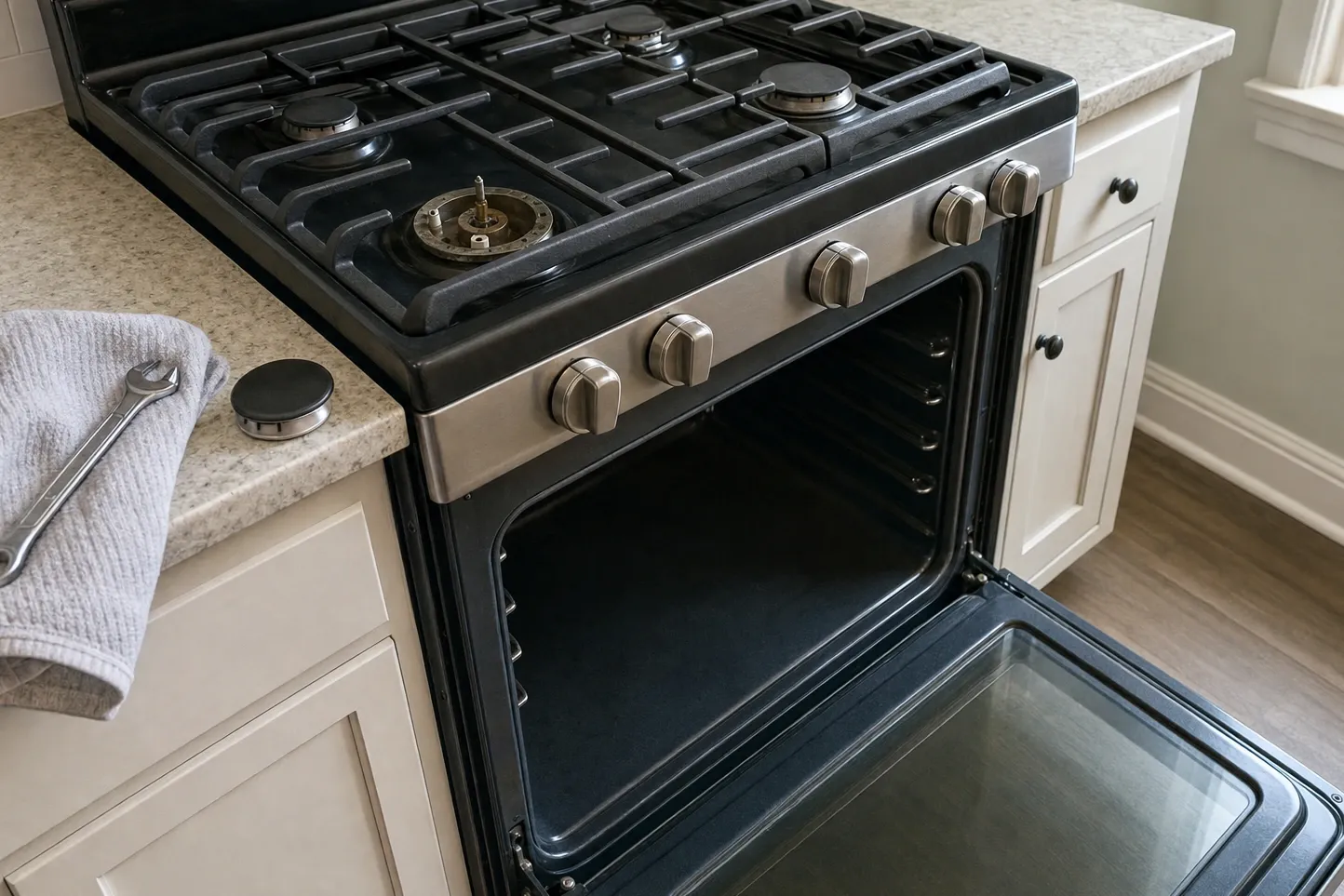
Nothing happens, or it moves and stops
Two faults hide behind one complaint. Silence at the button is the first: no note, no movement, nothing under the counter acknowledging the press. Partial travel is the second — the stack lifts, slows and settles back, or halts part way and refuses both directions. Telling them apart before anyone arrives is worth the minute it takes, because the two send a meter to different places.
The drive, and what tells it to run
A downdraft spends its life inside the counter and comes up out of it only when called, which is the form the manufacturer catalogues. Something drives that travel, and something separate tells the drive where the stack currently is. Silence usually belongs to the telling rather than the driving: a wall control, a cable run behind it, an output on a board. Partial travel belongs more often to the drive, or to the load it is pushing against.
Why pulling at the stack is the wrong move
Hands on the stack change the fault. The travel is driven rather than free, and forcing it works the mechanism backwards through whatever is holding it, so a switch fault that was only ever a switch acquires a mechanism fault beside it. Repeated presses do the same in slower motion. One press, one listen, then leave it for the meter.
What you can look at yourself
- Press once and listen at the counter edge. A faint note with no movement is a different fault from total silence, and whoever comes will ask which of the two it was.
- Clear the counter behind the cooktop. A knife block, a kettle or a board left over the slot is enough on its own to stall the travel.
- Look at the breaker serving the kitchen. A downdraft on a dead leg can still light its control panel and do nothing else at all.
- Stop there. Anything behind a panel, above the cabinets or on a roof is the visit — Wolf Repair Los Angeles, (310) 626-4008.
Follow-ups
Is it safe to keep pressing the button?
Twice is reasonable, then stop. Each command energises a drive that is already stalled, and the heat it makes has nowhere to go while the stack sits still. Nothing about a third attempt says anything the first two did not, and the part that gives up under that load is rarely the cheap one.
Can the cooktop still be used while the stack is down?
Losing the stack does not stop the burners; what it costs is capture at the cooktop. Cooking that smokes or steams hard is worth postponing until the travel works again, and an open window earns its keep meanwhile. Nothing about a stuck downdraft changes how the cooktop itself lights.