Range Repair
Wolf Burner Clicks and Clicks But Will Not Light
A Wolf burner that sparks but never catches is usually one of four things, and only one of them is a part. How to work out which one before anybody drives over.
Written by
Noor Haddad
- Trade
- Cooking-appliance technician — induction and electric
- Years on the tools
- 8 years in the trade
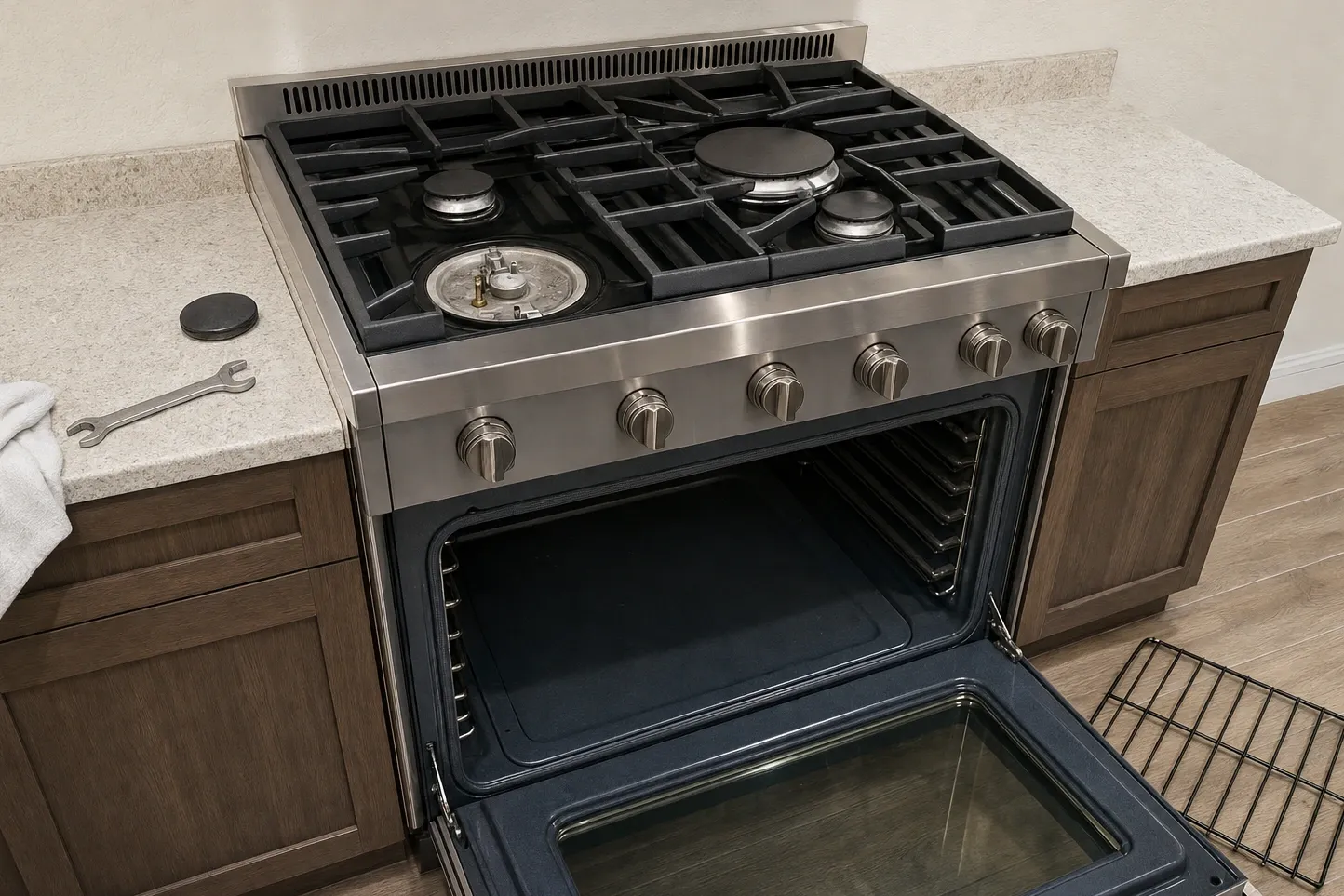
Few faults arrive on this shop’s phone more often than a Wolf burner that sparks away and never catches, and few can be narrowed down so far from the kitchen floor. The clicking is not the fault. The clicking is the range telling you that the spark side is doing its job and something else is not.
Before anything else: if the burner clicks for more than about ten seconds without lighting, turn the knob off. All that time, gas has been coming out of the burner and going nowhere. Give it a minute and open a window. If you can actually smell gas rather than just hear the clicking, leave the house and call the gas utility or 911 from outside. That is not an appliance call.
What the clicking actually is
A sealed burner on a Wolf range has two separate jobs happening at once. The valve lets gas through the orifice into the burner head, where it mixes with air and comes out of the ports around the rim. Independently, the spark module fires a high-voltage pulse at the electrode sitting in the burner well. When the two coincide, the flame lights and a flame sensor tells the module to stop sparking.
So a burner that keeps clicking after a flame is up has a sensing problem. A burner that clicks and never lights has one of four things wrong, and they are worth separating because three of them cost nothing to fix.
- The flame path is blocked. Ports clogged with old grease, a cap sitting crooked, or the burner head not seated after a clean.
- The burner is wet. Something boiled over, or the cooktop was washed and water ran down into the well. This is the single most common cause and it fixes itself with time.
- The spark is not reaching the gas. A cracked or filthy electrode, a chafed lead, or a spark module that has quietly given up.
- There is no gas arriving. Rare on one burner, very common on all of them at once, and almost always a supply problem rather than a range problem.
Start with the cheapest cause: wet, or dirty
Take the cap off the burner that will not light — cold, knob off — and look at it in daylight. You are looking for two things.
First, water. Any moisture in the well or on the electrode will short the spark to ground and you will hear it clicking with nothing to show for it. Dry it with a towel, then leave the cap off for an hour. In a Silver Lake kitchen after a spill-and-mop, that is frequently the whole repair.
Second, the ports. Run a fingernail or a stiff brush around the rim of the burner head. If the ports are dark and crusted, especially on the side nearest whatever usually boils over, the gas is not getting out evenly. Clear them with a brush or a straightened paperclip. Never open a port up with a drill bit — a widened port changes the flame and it cannot be undone.
Seat the cap flat when you put it back. A cap sitting on a crumb sits about a millimetre high, and that is enough to stop a burner catching cleanly.
When one burner is dead and the rest are fine
If three burners light and one does not, the gas supply to the whole appliance is clearly fine, so the fault is local to that burner. Try the match test: with the cap on and the burner head seated, hold a lit match at the rim and turn the knob to low.
If it lights off the match and burns normally, the gas side is healthy and the spark side is your problem. On a Wolf that usually means the electrode — cracked porcelain, or a build-up on the tip. Sometimes it is the lead: the igniter wire runs under the cooktop and where it crosses a bracket, years of heat cycling can rub the insulation through. It then arcs to the chassis instead of the burner, and you hear a click that is going nowhere. Both are small parts.
If it will not light off a match either, gas is not arriving at that burner. That is the valve, the orifice, or a spider nest in the tube on an older unit. Not a kitchen-table job.
When every burner clicks and none of them light
All four sparking and none catching almost never means four failed parts. It means the appliance is not getting the gas it expects.
Check the obvious first: has the shut-off valve behind the range been touched? Did work happen recently anywhere on the house gas? Is the oven also dead? If the oven lights and the burners do not, the manifold has pressure and the problem is distribution. If nothing on the range lights, look upstream.
The version specific to this city is worth its own paragraph. A great many kitchens on the east side had a modern range dropped into a house built long before anyone sold a 48-inch cooktop. If the gas drop feeding it was sized for a 1920s stove, the range will behave beautifully until two things want gas at once — then the simmer setting starves, a burner drops out when the oven lights, and eventually nothing catches at all during a big dinner. That is measured at the manifold with a manometer and it is a plumbing answer, not a parts answer. Replacing spark modules will not touch it.
What to check on a Los Angeles remodel before blaming the range
Three things account for most of the “it worked at the old place” calls.
The orifice may be wrong. A range converted for propane and then installed on natural gas will burn yellow, soot the pans and light badly. The orifices are stamped, and swapping them back is straightforward once somebody has looked.
Valley dust and hillside grit are real. Houses that stay open in the summer pull a remarkable amount of fine dust through a kitchen. It lands in burner wells and on electrodes, and after a few years it will hold enough moisture overnight to stop a spark. Two of the most common Studio City calls are exactly this, and both were cleanings rather than repairs.
A clean cycle can be the trigger. If the burners started misbehaving the day after a self-clean, the heat has usually cooked a lead or shifted a connector behind the panel. Say so on the phone — it names the part before anyone opens the range.
If the burner is dry, the ports are clear, the cap is seated, the other burners are fine and it still will not light off its own spark, that is where reading stops helping. The next test is a meter on the electrode lead and a gauge on the manifold, and both of them want somebody standing in front of the appliance.
Follow-ups
Is it safe to keep trying the igniter if the burner will not light?
A few attempts are normal. If it clicks for more than about ten seconds with no flame, turn the knob off and open a window before trying again — you have been releasing gas the whole time. If you can smell gas at all, stop, leave, and call the gas utility from outside.
Why does the burner light off a match but not off the igniter?
Because the gas side is fine and the spark side is not. That narrows it to a dirty or cracked electrode, a chafed igniter lead, or the spark module. It is the most useful single test you can do before calling.
Should I clean the burner ports myself?
Yes, on a cold burner, with the cap off and a stiff brush or a paperclip — never a drill bit or anything that widens a port. If the ports are clear and it still will not light, the problem is upstream of them.