Oven Repair
Wolf Oven Not Reaching Temperature: Reading the Drift
An oven that preheats forever, runs cool, or bakes forty degrees apart front to back is rarely the control board. What the pattern of the drift points at, and what to check before ordering anything.
Written by
Noor Haddad
- Trade
- Cooking-appliance technician — induction and electric
- Years on the tools
- 8 years in the trade
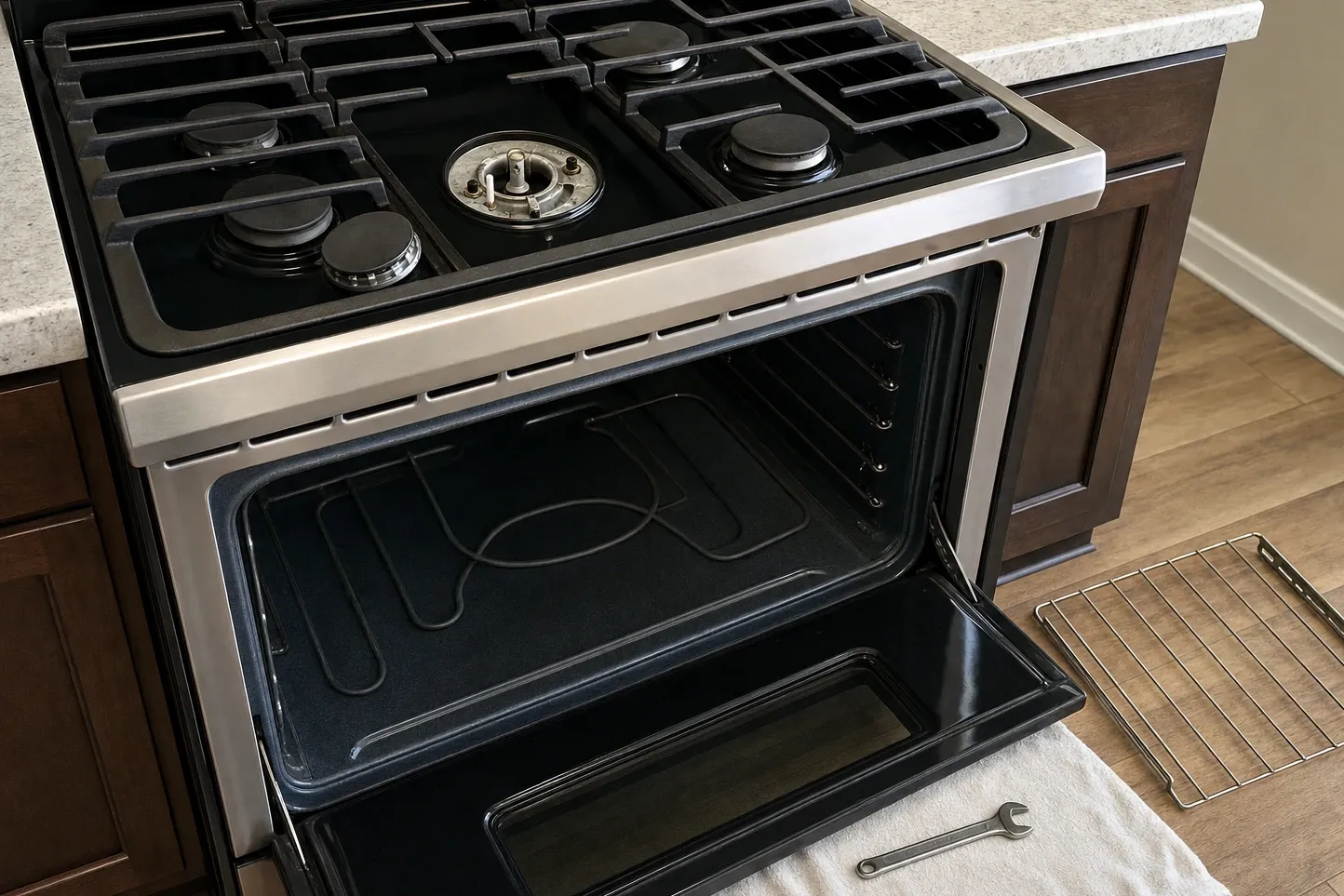
“The oven is not getting up to temperature” covers at least four different faults, and they are worth separating before anybody spends money. The useful information is not that it is wrong — it is the shape of being wrong. Slow but eventually right, permanently cool by a fixed amount, wandering, or hot at the back and pale at the front are four different repairs.
Measure it before you believe it
Almost every one of these calls starts with a guess and gets solved by a number, so get the number first. Put an oven thermometer in the middle of the centre rack, set the oven to 350, and leave it alone for twenty-five minutes after the preheat tone. Then read it three times, five minutes apart.
You now have something to work with:
- Consistently low by a fixed amount — say a steady 320 when you asked for 350. That is a calibration or sensor question.
- Low and never stabilising — it climbs, falls back, climbs again, and never settles. That is a heat-source or airflow question.
- Right in the middle, wrong at the edges — move the thermometer to the front of the rack, then the back. Twenty or more degrees between them is a convection or baffle question.
- Takes forever to arrive but gets there — that is usually loss, not weakness.
Write the three readings down. On the phone they are worth more than any description, because they decide which parts come along.
Slow to preheat, but it gets there in the end
An oven that eventually reaches temperature has a working heat source. Something is taking the heat back out again as fast as it is being made.
The first suspect is the door. Wolf oven doors are heavy, and after enough years the hinges sag a fraction and the seal compresses unevenly. Do the paper test: shut a sheet of paper in the door at the top, then at each corner, and pull. If it slides out easily at the top and grips at the bottom, the door is no longer sitting square and the hottest air in the cavity is going out over the top of the seal. New gasket, and often new hinge springs, because a stretched spring will flatten a new gasket inside a year.
The second is the seal itself, independently of the hinges. A gasket that has gone hard and shiny where it meets the frame has stopped sealing even if the door closes crisply. Run a finger round it. It should be springy the whole way.
The third, on a range rather than a wall oven, is the cooling fan. If the fan behind the control trim has seized, the electronics get hot, the board throttles, and the cavity struggles. Around here that shows up in July: a Studio City oven that behaved all winter and then went slow on a 100-degree afternoon is very often the cooling fan and a vent packed with lint, not the bake element.
It never gets there at all
If the cavity plateaus well below the set point and stays there, the heat source is down or the sensor is lying.
On an electric cavity, look at the bake element with a torch. A blistered, pitted or visibly deformed section near one end is a failing element, and it will often still glow — partly working is the normal way for them to fail, which is why “it heats a bit” does not rule it out.
On a gas cavity, watch the burner light through a preheat if you can see it. A lazy, yellow-tipped or lifting flame is an air or pressure problem rather than a dead part. A burner that lights and then drops out after a minute or two is usually the safety valve or its thermocouple giving up as it warms.
Either way, the sensor is the other half of the story. An oven temperature sensor is a resistor whose value changes with heat, and they age gradually: the resistance drifts, the board believes the drift, and the oven settles somewhere that is not where you set it. A drifting sensor is a small part and it is the most common single answer to “runs cool by exactly the same amount every time”.
If the display shows a fault code, write down the exact characters. It will not name the failed part on its own, but it does say which circuit the board lost confidence in, and that shortens the visit considerably.
Forty degrees apart front to back
Uneven baking with a correct average is nearly always air movement, not heat output.
Start with the convection fan. Listen for it in a convection or convection-assist mode. A fan that has lost a blade tip, or whose motor bearings have gone dry and slowed it, will still make a noise while moving very little air. On a range cavity you can usually see the fan cover on the back wall; on a wall oven it is behind a panel.
Then look for what is in the way. Two full sheet pans across a single rack turn the cavity into two rooms and no fan will fix that. Foil on the oven floor does the same thing to a gas cavity, and it is worth removing before assuming a fault. And on a range with a griddle plate, cooking hot at the back and barely warm at the front is frequently a partly blocked burner underneath rather than anything to do with the oven at all.
Steam ovens, and Los Angeles water
Steam ovens deserve their own paragraph because they fail differently and the cause here is nearly always local. Los Angeles water is hard. Scale builds in the reservoir path, on the level sensor and around the pump inlet, and the result is an appliance that reports a fill error with a full tank, or stops partway through a cycle, or produces steam that smells faintly of nothing pleasant.
Descaling is maintenance, not repair, and doing it on the interval in the manual is the single most useful thing an owner of one of these can do — particularly in Los Feliz and the hillside blocks, where the water is often carrying more mineral than the appliance was designed around. Once a level sensor has scaled up, though, it usually wants replacing rather than cleaning.
If the thermometer says the cavity is out, the door passes the paper test, the seal is springy and nothing is visibly wrong with the element or the flame, then the remaining candidates are the sensor, the board and the calibration, and telling them apart needs a meter on the sensor leads at temperature. That part is a visit.
Follow-ups
How far out is a Wolf oven allowed to be?
A healthy cavity holds within roughly ten to fifteen degrees of the set point once it has stabilised, swinging either side of it as the burner or element cycles. Consistently twenty-five or more degrees low, or a swing wider than about forty degrees, is a fault rather than a characteristic.
Can I just recalibrate it myself and be done?
Sometimes, and it is worth trying if the oven is evenly and consistently cool by a fixed amount. Calibration cannot fix a drift that changes with temperature, a cavity that never stabilises, or heat escaping past a tired door seal — you would only be hiding those.
Why does the display show the right number when the oven is clearly cold?
Because the display shows what the sensor reports, not what the cavity is doing. A sensor that has drifted low tells the board the oven is cooler than it is and the oven overshoots; one drifting high does the opposite. That is why the first real test is a thermometer on the rack.